Posts

Explain the structure of sporangiophore and dehiscence of sporangium of Rhizopus?

Image
  Explain the structure sporangiophore and dehiscence of sporangium of Rhizopus?  Rhizopus is a widely distributed genus of about ten filamentous fungal species in the family Rhizopodaceae (formerly Mucoraceae) of the order Mucorales. Numerous species are important for industry, and some cause diseases in both plants and animals. One such species is Rhizopus stolonifer, sometimes known as the common bread mold.Rhizopus is a widely distributed genus of about ten filamentous fungal species in the family Rhizopodaceae (formerly Mucoraceae) of the order Mucorales. Numerous species are important for industry, and some cause diseases in both plants and animals. One such species is Rhizopus stolonifer, sometimes known as the common bread mold. When two compatible and physiologically different mycelia are present, rhizopus can reproduce sexually. The quickly proliferating colonies have a texture akin to cotton candy, sometimes known as candy floss or fairy floss, and change from white...

Watson and crick model of DNA

Image
  Watson and Crick Model of DNA  Many people think that in the 1950s, English physicist Francis Crick and American biologist James Watson discovered DNA. This is not the situation in actuality. Rather, Swiss chemist Friedrich Miescher discovered DNA for the first time in the late 1860s. Then, in the decades that followed Miescher's discovery, a number of studies conducted by other scientists—most notably,  Phoebus Levene and Erwin Chargaff—uncovered more information about the DNA molecule, including its main chemical constituents and the ways in which they interacted with one another. Watson and Crick may never have come to their ground-breaking conclusion in 1953—that the DNA molecule exists as a three-dimensional double helix—without the scientific groundwork laid by these pioneers. https://educationtechbysapna.blogspot.com/2024/04/structure-and-function-of-cyphellae-and.html The year 1869, albeit little known to most, was a turning point in the history of genetics stud...

Structure and Function of Cyphellae and cephalepodia in Lichens

Image
  Structure and Function of Cyphellae and cephalepodia in Lichens      Cyphellae ( photobionts)   are smooth- surfaced depression in the thallus of lichen and are responsible for exchange of the gases.  A minute, rimmed, cup-like depression or pore, found in lichens of the genus Sticta, which is visible in the lower surface of the thallus as a small white pit.               cephalepodia  (Mycobiont)   A number of lichens have an alga as the major photobiont but with a cyanobacterium present as a minor photobiont in discrete pockets and such pockets are called cephalepodia.  The basic structure of a lichen is like that of the popular peanut butter cup candy. A layer of photobionts (the peanut butter) is held within a matrix of fungal fibers or hyphae (the chocolate). This allows the photobionts access to sunlight as well as protection from drying out. https://educationtechbysapna.blogspot.com/2024/03/gly...

Understanding the Basics of Fat: A Comprehensive Guide

Image
https://educationtechbysapna.blogspot.com/2024/03/lichens-structure-and-function-of.html   The Ultimate Guide to Different Types of Dietary Fats    One of the three macronutrients that give the metabolic system the energy it needs to run properly is fat. Both unsaturated (good fat) and saturated (bad fat) fats are vital components of our daily diet and are required for our continued health. The foods we eat include both unsaturated and saturated fats. Two different kinds of fats:  You must examine the two types of dietary fats—saturated and unsaturated—in greater detail in order to comprehend the function that fats play in a healthy diet. (Trans fats, a third type, are virtually nonexistent in American diet.)   Saturated:  This fat is referred to as "bad" fat. Animal foodstuffs like beef and pork as well as high-fat dairy products like butter, margarine, cream, and cheese are the main sources of it. A lot of quick, processed, and baked items including pizza...

Cilia and Flagella : A comparative analysis

Image
 Cilia and Flagella : A comparative analysis  Although they have similar structures, flagella and cilia are two different kinds of cell organelles that have different lengths and functions. Within each cell, there are hundreds of short and many cilia. Contrarily, there are fewer and longer flagella (often one to eight) per cell. Despite having the same structural makeup, motile cilia and eukaryotic flagella can have different beating patterns. Cell exterior features called flagella and cilia mainly facilitate cell motility. Some cells have a huge number of short, hair-like projections called cilia covering their surface. Only one end of a cell contains the long, thread-like structures called flagella.                Unlike flagella, which beat separately, cilia beat in unison. Only eukaryotic cells contain cilia. Both prokaryotic and eukaryotic cells have flagella. Undulipodia organisms have both motile cilia and flagella. The primary fu...

The Hidden Connections: Surprising Similarities and comparision Between Peroxisomes and Mitochondria

Image
The Hidden Connections:  Surprising Similarities and comparision between Peroxisomes and Mitochondria Peroxisomes and mitochondria are incredibly active types of organelles. They have great plasticity and can take on many forms according on the needs of the cell.  Depending on the physio-pathological environment or the metabolic requirements of the cell, their number and shape can vary. The range size of peroxisomes and mitochondria is 0.1 to 1 μm. On the other hand, their structures are different.  Peroxisomes have a single membrane system encircling them, whereas mitochondria have two membrane systems surrounding them.  Peroxisome and mitochondrial counts in cells differ depending on the type of cell (e.g., mitochondria are plentiful in brown adipose tissue but relatively sparse in white adipocytes).  In terms of fatty acid metabolism, mitochondria degrade the majority of long-chain fatty acids to supply acetyl-CoA for the production of ATP and for anabolic re...

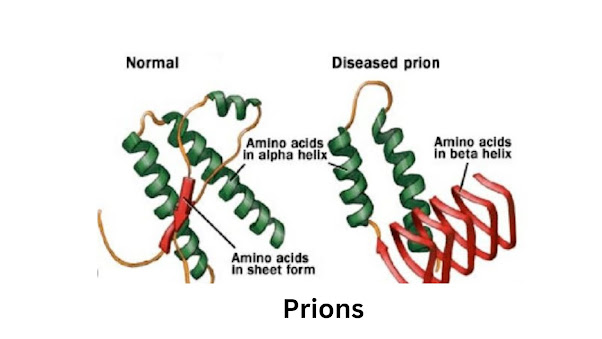
Prions and machanism of transmission of prions

Image
 Prions  The term Prion means proteinaceous infectious particles. Prions are the infectious agents responsible for several neurodegenerative diseases in mammals, like, Creutzfeldt Jakob disease. This happens due to the abnormal folding of the proteins in the brain. It refers to the hypothesis that the infectious agents causing the diseases contain only proteins. It explained why the infectious agents are resistant to ultraviolet radiations. They can break down the nucleic acids, but are receptive to substances that denature proteins. https://educationtechbysapna.blogspot.com/2024/03/how-sem-scanning-electron-microscopy-is.html Prion diseases are transmissible, untreatable, and fatal brain diseases of mammals. Their cause is highly unusual: The host’s normal prion protein can, for unknown reasons, malfunction and assemble into structured aggregates called prions that cause infectious brain disease. This process – which can be underway for years before symptoms appear – likely c...